

Heat pump
A propane monobloc, 4 to 16 kW, running at 28 dB(A) and joining the same control system as your panels and your battery.
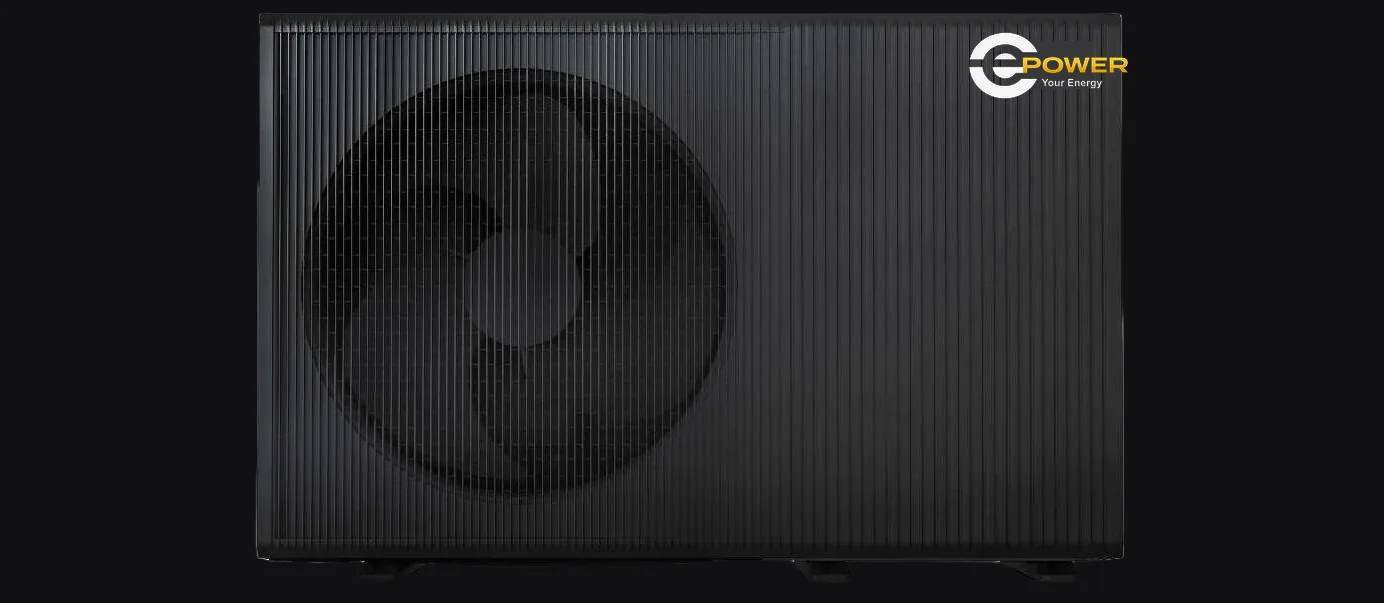
We do not yet have a full datasheet for this product, only the manufacturer’s published figures. The values in the table below come from the product page rather than from a technical sheet, which is why the dimensions, the weight and the exact SCOP per model are missing. We supply those with the quote, along with the model that suits your home.
A heat pump takes heat from the outside air and brings it indoors. That works, including in frost, but how well it works depends almost entirely on the house around it and not on the appliance.
That is why this starts with a heat loss calculation and not with a brand.
This heat pump is called Thermo, with the output after the name: Thermo 4 through Thermo 16.
The two figures that stand out here
28 decibels at three metres. That is quiet enough to decide whether the unit may stand near your boundary, and noise is the first complaint people have about a heat pump. Where your council sets a noise limit, this is the number it comes down to.
80 degrees flow temperature, including at ten degrees of frost. That is why this version can also work in an existing house with ordinary radiators. Most heat pumps reach 55 degrees and therefore ask for larger radiators or underfloor heating first.
That does not mean it is always sensible. Running at 80 degrees costs efficiency: the higher the flow temperature, the less heat you get per kilowatt hour of electricity. A heat pump running at 80 degrees all winter is an expensive electric heater. The calculation shows the temperature at which your house gets warm, and that is the figure that counts.
Why monobloc
In a split system refrigerant runs from the outdoor unit to an indoor unit. In a monobloc everything sits outside and only water goes in.
That saves on installation, on maintenance, and on the qualifications needed to work on it. It costs you something in pipe losses between outside and inside, and that is the trade.
Propane as refrigerant
R290 is propane. It has a global warming potential of 3, against several hundred to several thousand for the synthetic refrigerants it replaces. It is also flammable, which is why there are clearance rules for where the unit may stand.
Those rules are not a formality: they decide whether the unit can go in the spot you have in mind. We check that on site, together with the noise limits your council sets.
What comes first
A heat loss calculation per room. That determines how much output you need, and it is almost always less than people think. A heat pump that is too large switches on and off too often and wears out faster for it.
The same calculation shows the flow temperature at which your house gets warm. If that comes out above 55 degrees, the question is not which heat pump but whether this is the right moment. Insulating or replacing radiators then returns more than installing a heat pump.
That is the answer you get from us when it turns out that way. It costs us an order and it saves you an energy bill that disappoints.
Together with your panels and your battery
A heat pump is the largest electrical item in a house that has one. Which is exactly why it is worth running when your own power is available or when the price is low.
The energy manager handles that, controlling the heat pump on your output, your battery and your tariff. Without that link it runs whenever the thermostat asks for it, and that is not necessarily the cheapest moment.
If you are considering panels and storage alongside it, solar with storage is the starting point.
Specifications
- Type
- monobloc, all refrigerant in the outdoor unit
- Refrigerant
- R290 (propane), global warming potential 3, with four leak protections
- Output range
- 4, 6, 8, 10, 12, 14 and 16 kW
- Energy label
- A+++ at 35 °C and at 55 °C flow temperature
- Efficiency
- COP up to 4.75
- Output in frost
- 100% heating capacity at −7 °C
- Maximum flow temperature
- 80 °C, including at −10 °C outside
- Operating range
- down to −25 °C
- Noise
- 28 dB(A) at 3 metres
- Control
- three zones, or two zones plus swimming pool; 7-inch touch display
- Cascade
- up to 8 units can be linked
These figures come from the manufacturer datasheets and apply under standard test conditions. What an installation delivers at your site depends on your roof, your consumption and your connection; we work that out during the measurement.
The range
The same technology in several sizes. Which one fits you follows from the calculation; this is what there is to choose from.
Thermo 4 and 6
The two smallest sizes, for a well insulated flat or a small terraced house. They make no more noise than the larger versions.
What those figures mean
- 4 and 6kWheat output
- How much heat the pump can put into the house per hour. Which size you need follows from the heat loss calculation for the property, not from the type of house.
Thermo 8 to 12
The sizes that most Dutch homes come out at. At seven degrees of frost the pump still delivers full output, so no electric element has to step in.
What those figures mean
- 8 to 12kWheat output
- How much heat the pump can put into the house per hour. Which size you need follows from the heat loss calculation for the property, not from the type of house.
Thermo 14 and 16
For a detached house or a house with moderate insulation. Up to eight units can be linked for larger buildings, and the flow temperature reaches 80 degrees, even at ten degrees of frost.
What those figures mean
- 14 and 16kWheat output
- How much heat the pump can put into the house per hour. Which size you need follows from the heat loss calculation for the property, not from the type of house.
Outputs, efficiencies and warranty terms come from the manufacturer datasheets and warranty documents and apply under standard test conditions. Terms can differ per country; what applies to your installation is stated in the quote.
Goes with this
Parts that in practice are nearly always looked at together.
Air conditioning
Cooling in summer and additional heating in the shoulder seasons, at 22 dB(A) indoors and with a SCOP of 4.7.
Electric water heater and boiler
Hot water and heating without a gas connection: a 150-litre cylinder, or an electric boiler of 24 kW.
Charge point at home
A charge point at your own house, fitted to your existing meter cupboard where possible, with an honest price up front.
Not sure what you need?
Describe what is happening at your location. Working out what fits is our job, and we will tell you if it does not pay for itself.